
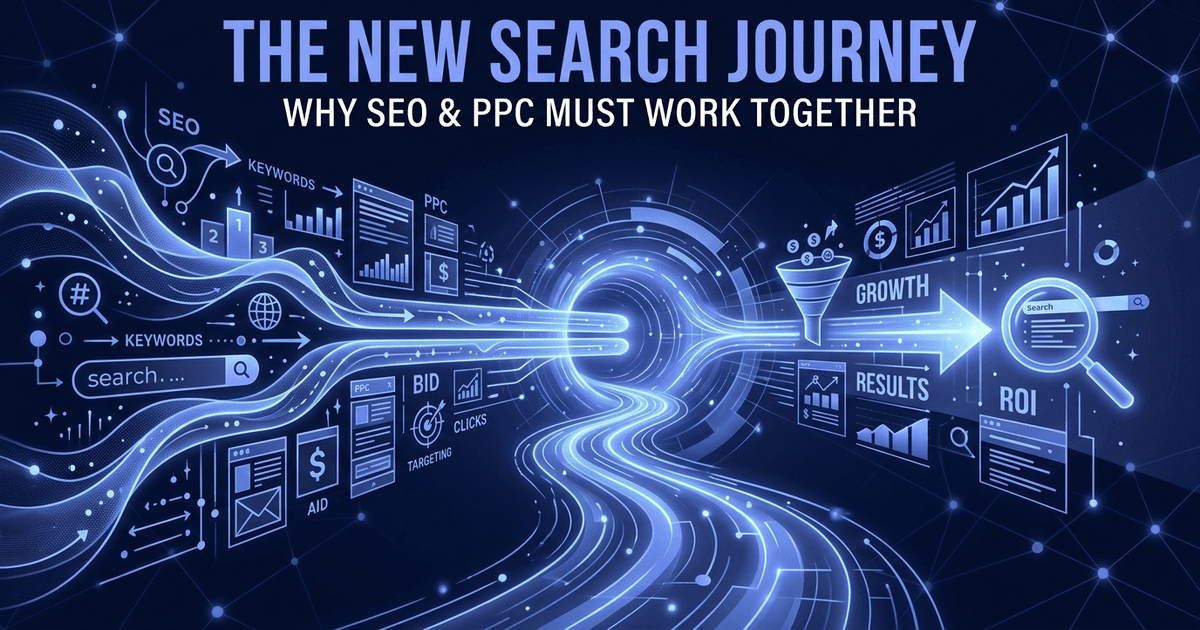
How do your customers find you online? For years, marketers tracked a simple, straight line. A user typed a keyword, clicked a link, and bought a product. Today, that linear path is gone. The new search journey is a loop where AI, paid ads, and organic results constantly feed into one another. If you still manage your search channels in separate silos, you are likely wasting your budget.
The Death of the Straight-Line Search
Let's look at the data. A June 2026 study by SparkToro found that 68.01% of Google searches now end without a single click to an external website. This is up from about 60% in 2024. Why are people clicking less? Because Google now answers their questions directly on the results page.
But that is only half the story. The same study showed that the share of searches leading to a follow-up query rose by 7.2 percentage points. People do not just search once and stop. They refine their questions, compare options, and search again.
As search expert Kenneth Hamner, Founder of Funnel Digital Marketing, wrote in Search Engine Land:
"The journey is now a loop, not a line."
Instead of a straight line to a purchase, buyers now cycle through a four-stage loop. To win customers today, you must show up at every turn of that loop.
The Four Stages of the Loop
To understand how search has changed, we must look at how users interact with Google today. The journey now breaks down into four distinct phases.
Stage 1: AI answers shape the consideration set.
The journey usually starts with a broad question. When users search for comparison or question-based terms, Google often serves an AI Overview. A study by Seer Interactive revealed that comparison queries trigger an AI Overview 95.4% of the time. For general questions, they appear 85.9% of the time. The AI summarizes the options and names two or three brands. This narrows the user's focus before they ever click a link.
Stage 2: Paid ads capture filtered demand.
Many marketers feared that AI Overviews would kill paid search. The reality is different. When an AI Overview appears, it filters the noise. The searcher now has a specific intent. According to Seer Interactive's data, paid click-through rates actually rose from 14.6% to 16.2% on queries with an AI Overview. Text ads are capturing the highly qualified traffic that the AI has already primed.
Stage 3: Organic results reinforce the decision.
What about organic search? Organic click share has dropped in many commercial categories. For example, Similarweb data showed organic click share for headphones dropped from 73% to 50% between January 2025 and January 2026. However, organic search is still where users go to confirm their choices. They look for deep-dive articles, reviews, or forum threads to make sure they are making the right decision.
Stage 4: Follow-up queries restart the loop.
Every search leads to another. A user might search "best CRM for agencies," see an AI overview, and then search "HubSpot vs Salesforce." After that, they might search "HubSpot integration issues." Each step is a new query. If you only rank for the first term, you lose the buyer on the second or third step.
Why AI Citations Are the New Trust Signal
If you want to win this loop, your brand must be cited by Google's AI. A citation is not just good for search engine optimization. It acts as a massive trust signal that boosts all your channels.
The data supports this connection. Seer Interactive found that brands cited inside an AI Overview earned 35% more organic clicks. Even more surprising, they also saw a 91% increase in paid clicks compared to uncited brands on the exact same queries.
As Hamner explains:
"The citation acts as a trust signal and lifts both the listing and the ad to the same page. That is where the two disciplines fuse."
How do you earn these citations? You cannot buy your way into an AI Overview. The AI pulls from authoritative, original sources. Standard "how-to" articles or generic definitions will not work anymore. AI models can already write that content themselves. Instead, you need to publish original data, proprietary research, and unique case studies.
Of course, we must look at this data with a critical eye. Tracy McDonald, the Study Lead at Seer Interactive, shared an important caveat:
"We cannot definitively prove that citation causes higher CTRs; it's equally possible that brands with stronger authority and higher baseline CTRs are simply more likely to be cited by Google's AI."
Either way, building brand authority remains the key. Stronger authority leads to more citations, which leads to more clicks across paid and organic channels alike.
Shifting Your Strategy for the New Search Journey
How should your business adapt to this new environment? You must stop managing SEO and PPC as separate projects. They are two halves of the same system.
First, map your customer journeys by query chains. Do not just track single keywords. Look at the entire path your customers take. Use tools like Semrush or Ahrefs to see which of these queries trigger AI Overviews.
Second, review your campaign data carefully before cutting budgets. If a query triggers an AI Overview and your brand is cited, keep investing in it. Even if the direct click-through rate looks low, that citation is building the trust that drives your paid ad conversions later in the loop.
Finally, fund original content. Treat proprietary data as a core business asset. If you run a local service business, publish deep, practical guides based on your real-world projects. If you run a software company, run industry surveys and publish the findings. This is the exact type of content that Google's AI loves to cite.
The linear path to conversion is dead. Today, searchers loop through AI answers, paid ads, and organic reviews before making a choice. Businesses that adapt to this loop will win. Those that keep their marketing in separate silos will get left behind. It is time to connect your search strategy.
Related Articles
AI Shopping SEO: How to Make Sure Machines Recommend Your Products
AI systems cannot recommend products they do not understand. Learn how to optimize your brand knowledge infrastructure so machines can find and trust your data.
Can Long-Term A/B Testing Trigger an SEO Penalty?
Google's John Mueller recently cleared up a major contradiction about running long-term A/B tests. Here is what business owners and marketers need to know about testing without losing search rankings.
How Google’s Universal Commerce Protocol Changes E-Commerce SEO
AI can discover, compare, and buy products on users' behalf. Learn how to prepare your product data, Merchant Center, and structured data.
Ready to Start Your Project?
Let's build something amazing together. Get in touch to discuss your next digital project.
Get in Touch